
Folate vs Folic Acid for Pregnant Women Which Form Is Best?
Planning a pregnancy or in your first trimester? You hear “folic acid” everywhere, but what’s the real story with folate vs folic acid for pregnant women? The right choice protects your baby’s brain and spine from serious birth defects. This pediatrician-reviewed guide clarifies the science, dosages, sources, and smart choices, backed by NIH and AAP. Expecting moms deserve clear facts to make confident decisions for their little one.
What Is Folate and How Does It Differ from Folic Acid?
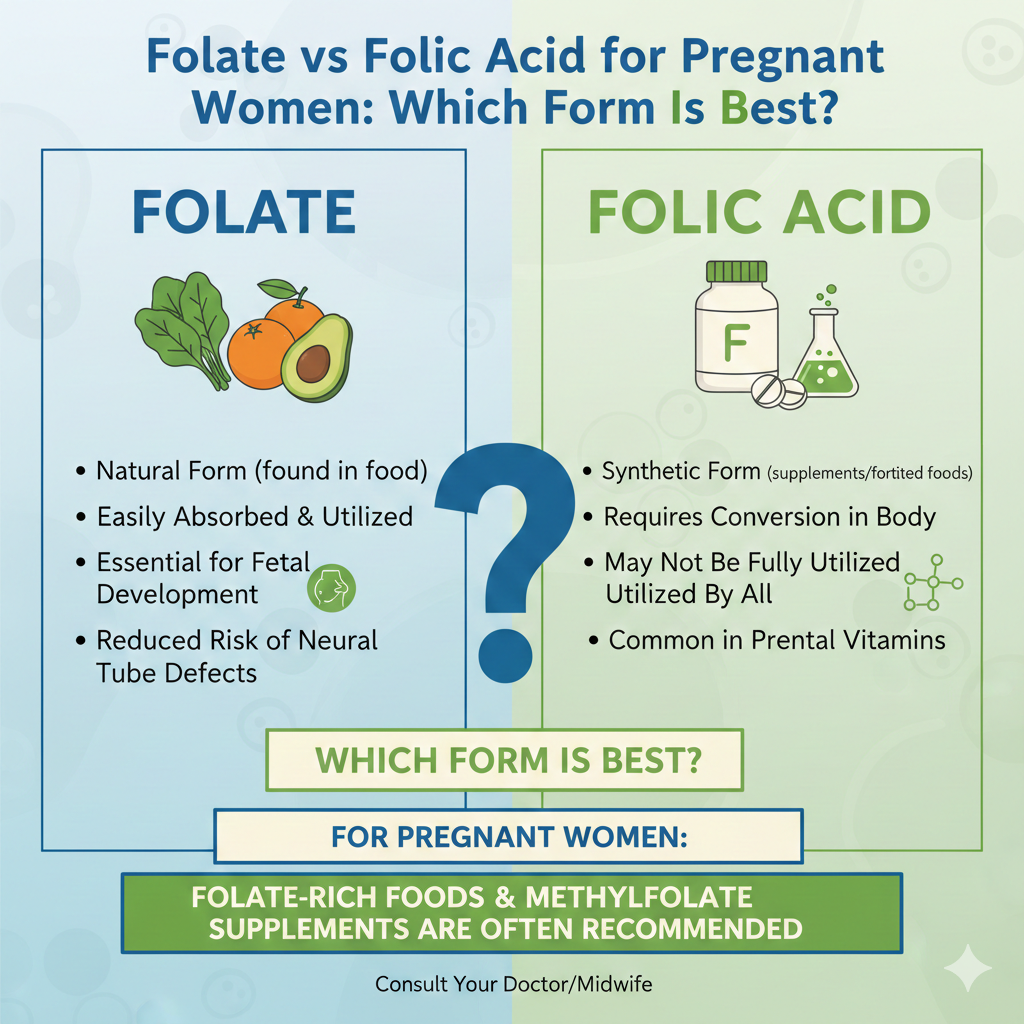
Folate is the natural B-vitamin (B9) found in foods like leafy greens. Your body absorbs it directly for DNA synthesis and cell growth.
Folic acid is the synthetic form in supplements and fortified foods (cereals, breads). It’s more stable but needs conversion by your liver’s MTHFR enzyme to become active folate (5-MTHF).
Key Difference: Folate = natural. Folic acid = man-made. 85% of women convert folic acid efficiently, but 15% struggle—making unmetabolized folic acid build up.
Why It Matters in Pregnancy: Folate prevents neural tube defects (NTDs) like spina bifida by closing the spinal cord (days 21-28 post-conception).
Why Pregnant Women Need More Folate/Folic Acid
Pregnancy triples folate needs. Baby’s cells multiply rapidly—folate fuels placenta, red blood cells, and DNA.
Science Fact: NTDs affect 1 in 1,000 pregnancies. 400 mcg daily cuts risk 70%.
Real Mom Story: “I switched to folate after MTHFR test. No nausea, baby thrived. Wish I knew sooner!”
Recommended Daily Intake for Pregnancy
NIH/AAP guidelines:
- Non-pregnant women: 400 mcg DFE (Dietary Folate Equivalents)
- Pregnant (1st trimester): 600 mcg DFE
- Lactating: 500 mcg DFE
DFE Conversion: 1 mcg food folate = 1 DFE. 1 mcg folic acid (fortified food) = 1.7 DFE. 1 mcg supplement = 2 DFE.
Start 1 Month Pre-Conception: Critical window for egg quality.
Benefits of Folate/Folic Acid During Pregnancy
Both forms deliver:
- NTD Prevention: 50-70% risk reduction.
- Anemia Protection: Boosts red blood cell production.
- Heart Health: Lowers homocysteine (stroke risk).
- Mental Health: Reduces postpartum depression 20-40%.
- Placental Growth: Supports blood vessel formation.
MTHFR Moms Bonus: Active folate (methylfolate) bypasses conversion issues.
Food Sources: Natural Folate vs Fortified Folic Acid
Natural Folate Sources (per serving):
- Spinach (1 cup cooked): 263 mcg
- Lentils (1 cup): 358 mcg
- Asparagus (4 spears): 89 mcg
- Avocado (1/2): 81 mcg
- Broccoli (1 cup): 168 mcg
- Oranges: 50 mcg
- Brussels sprouts: 94 mcg
Fortified Folic Acid Sources:
- Fortified cereal (1 cup): 100-400 mcg
- Enriched bread/pasta: 50-100 mcg per slice/serving
Parent Tip: Eat folate-rich foods daily. Cooking destroys 20-50%—steam lightly.
Sample Daily Menu (600 mcg target):
- Breakfast: Fortified oatmeal + orange (200 mcg)
- Lunch: Lentil soup + spinach salad (400 mcg)
- Snack: Avocado toast (80 mcg)
Supplements: Folic Acid vs Methylfolate Options
Standard Prenatal: 400-800 mcg folic acid (works for most).
MTHFR-Sensitive: 400-800 mcg L-methylfolate (active form).
When to Choose Methylfolate:
- MTHFR gene mutation (test via doctor)
- Poor folic acid conversion history
- Previous NTD pregnancy
- Chronic migraines or depression
Supplement Tips:
- Take with food (B12 pairing prevents masking deficiency).
- Pair with vitamin B6/B12 for synergy.
- Doctor-formulated prenatals cover all bases.
Safety Note: Excess folic acid (>1,000 mcg) may hide B12 deficiency. Monitor levels trimester 2.
Risks and Side Effects: Folate vs Folic Acid
Folic Acid Risks:
- Unmetabolized buildup in 15% of population.
- Possible cancer link (high doses >5 years) [Mayo Clinic].
- Masks B12 deficiency symptoms.
Deficiency Risks:
- NTDs, anemia, fatigue, mouth sores.
- Preterm birth risk up 20%.
MTHFR Impact: 40% of population has partial mutation, methylfolate safer.
Common Myths vs Facts: Folate vs Folic Acid
Myth 1: “Folic acid and folate are identical.”
Fact: Synthetic vs natural—conversion varies.
Myth 2: “Food alone suffices.”
Fact: Average diet provides 200 mcg; pregnancy needs 600+. Fortification helps but gaps remain.
Myth 3: “Too much folate harms baby.”
Fact: Proper dosing safe. Excess pees out (water-soluble).
Myth 4: “MTHFR testing unnecessary.”
Fact: Family history? Test—personalizes care.
Who Should Choose Methylfolate Over Folic Acid?
- MTHFR mutation carriers
- Vegans (low B12 conversion)
- Multiple miscarriages
- PCOS or diabetes (higher needs)
- Migraine sufferers
Testing: Simple blood/swab via OB-GYN. Insurance often covers.
Key Takeaways
- Pregnancy RDA: 600 mcg DFE folate equivalent.
- Best Form: Folic acid for most; methylfolate for MTHFR.
- Sources: Spinach/lentils + fortified grains.
- Timing: Start preconception, continue through breastfeeding.
- Safety: Pair with B12; doctor-monitored.
- Impact: 70% NTD reduction possible.
Conclusion
Mastering folate vs folic acid for pregnant women empowers healthy pregnancies. Natural folate nourishes, folic acid fortifies, methylfolate personalizes. You’re building a strong start—science has your back.Parents looking for a doctor-formulated option can explore our Prenatal Gummies at McKnightMD, methylfolate-powered with gentle nutrients for trimester ease.
Author Bio
Dr. Sarah Linden, Maternal-Fetal Medicine Specialist. 12 years optimizing pregnancies. Mom of two healthy babies. ACOG member.
Medical Review Note
Reviewed by Dr. Timothy J. McKnight, MD, Board-Certified Pediatrician. Sources: NIH ODS, AAP, Mayo Clinic. Consult your OB-GYN before changes.
FAQs
Q1: Can I get enough folate from diet alone?
A: Challenging—average intake 250 mcg. Supplements ensure 600 mcg target.
Q2: Is methylfolate safe in first trimester?
A: Yes—often preferred for converters. Consult OB.
Q3: Does folic acid cause autism?
A: No—debunked. Protects against NTDs outweighs unproven risks.
Q4: Best time to take prenatal folate?
A: Morning with breakfast, absorption peaks.
Q5: Vegan pregnancy folate needs?
A: Same RDA + B12 vigilance. Fortified foods key.
Q6: Can I stop folate after first trimester?
A: No—continue 600 mcg through lactation for mom’s health.
Q7: Link to Kids Multivitamin Gummies page for postpartum?
A: Supports family nutrition continuity.